
Fields in Bell County Property Tax Records
Bell County property tax records start with parcel identity. Then they split. The PVA parcel card is the assessment source and holds the valuation layer. A bill or certificate of delinquency comes later in collection, and treating it as the same record invites confusion.
| Record field | Meaning | Official source |
|---|---|---|
| Parcel and account | Keys for matching the tax parcel | Bell PVA/qPublic |
| Land and improvement values | Separate parts of the assessment | Bell PVA/qPublic |
| Total and net taxable value | Value before and after applicable relief | Bell PVA/qPublic |
| Working and certified year | Draft-current versus completed roll context | Bell PVA/qPublic |
| Exemption | Relief shown on the assessment card | Bell PVA |
| Bill stage | Discount, face, penalty, or delinquency status | Local collector and County Clerk |
Kentucky generally assesses real property at estimated fair cash value, with a special agricultural valuation where the law allows it. No Bell-specific fractional ratio appears in the published guidance. The state simply leaves that number unstated. A sale price is just a transaction field, not a substitute for the PVA assessment or an appraisal.
Search Bell County Property Tax by PVA Fields
The Bell PVA route runs through qPublic. Modes include all fields, name, address, parcel ID, and alternate ID, so pick the least ambiguous key. Same-name and road-name confusion favors the parcel number.
| Search mode | Input to try | Result details to save |
|---|---|---|
| Address | Street number and road, with route variants | Location address, parcel, tax district |
| Owner | Indexed name, then first name or initial | Owner field and mailing address |
| Parcel ID | All leading zeroes, hyphens, and decimals | Exact parcel and account numbers |
| Alternate ID | Known secondary identifier | Cross-reference to the same card |
The public search costs nothing. Its card is tax information, not a legal deed. Values can move before the next certified roll, so preserve the data-upload date and the year labels that come with them. The qPublic entry page is where a Bell County parcel lookup begins.

Use this entry for parcel cards; collection stays separate.
Bell County Working and Certified Tax Values
A Bell County parcel card can show a 2026 Working Value beside a 2025 Certified Value. An upload stamp of March 3, 2026, rides along with them. The pairing is the point. A current work layer sits next to the prior certified roll. Nothing posts at once. Sales, exemptions, and new improvements each land on their own schedule.
The same card separates land value, improvement value, total value, exemption, and net taxable value. Compare like years only. A working value may still move. The certified figure marks the completed roll for its cycle. These numbers sit apart from billing. For how they work, see the Bell County property value guide.
Identity fields ride along with the values. They include Owner, Mailing Address, Location Address, Deed Book/Page, and a sales row. Keep them with the value snapshot. Otherwise a comparison can drift to a different parcel. The mailing address serves tax communication. The location address identifies the site. Neither one proves occupancy. The deed reference remains the route to the recorded transfer.
Trace a Bell County Property Tax Bill
A bill search starts with the parcel identity. From there, move to the local collection source. The Bell Clerk publishes delinquent-tax information. Kentucky DOR supplies the statewide calendar and explains when unpaid bills become certificates of delinquency.
- Search the Bell PVA card by address and copy the exact parcel ID, account, owner, and tax district.
- Locate the bill for the correct tax year through the local collection route and compare the parcel key.
- Read the bill stage and amount, then compare exemptions and taxable value with the PVA card.
- If the bill has passed the sheriff's collection period, check the Clerk's delinquent-tax page and any certificate or assignment record.
- Ask the relevant office to confirm a current payoff, release, or payment state before relying on it.
- Assessed value
- The PVA valuation used in the tax process under Kentucky law.
- Levy or rate
- The charge applied by a taxing authority to its tax base.
- Homestead exemption
- Statutory tax relief that must be shown as applied to affect the net figure.
- Tax lien
- A claim tied to unpaid property tax, subject to payment, assignment, or release.
Kentucky's Bell County Property Tax Calendar
Kentucky DOR lays out a staged annual calendar. Pay October 1 through November 1 and get a 2 percent discount. November 2 through December 31 costs the face amount. January adds a 5 percent penalty. February 1 through April 15 carries a 21 percent penalty.
After April 15, the sheriff transfers unpaid bills to the county clerk. They become certificates of delinquency and liens. Costs climb from there. DOR describes 1 percent monthly interest. It also lists a 10 percent county-clerk fee and a 20 percent county-attorney fee. Notices follow, and certificates may be offered to third-party purchasers from mid-July into late October. The calendar names the stage. It cannot say whether one parcel has paid, entered an installment plan, or received a release. So confirm the actual Bell bill and its current status.
DOR adds that sale listings are advertised in a local newspaper at least 30 days before a sale. It also notes that installment plans may be available. A list entry is a dated stage only. It is not proof of the amount owed today. Record the certificate number, owner, parcel, tax year, assignment history, interest, fees, notice dates, and any release. If a certificate has been assigned, confirm the holder and the current payoff through the official local route. Do not estimate from the original bill.
Bell County Exemptions and Agricultural Value
Every PVA card carries exemption and net taxable fields. A card may list Homestead as No. That describes the parcel, not the owner's eligibility. The Bell County PVA sets the current application and evidence rules. Ask that office directly before seeking relief. Confirm it lands in the correct assessment year.
Kentucky also allows agricultural valuation for qualifying farm land. This replaces the ordinary fair-cash-value measure. Do not read agricultural status out of acreage, a rural ZIP, or a road name. The PVA classification and the applicable filing control the question. New construction goes onto the tax roll annually. The PVA physically inspects each parcel at least once every four years. Values can still change in any year.
For ordinary real property, Kentucky recognizes three approaches: sales comparison, cost, and income. Sales comparison weighs comparable transfers, cost figures replacement less depreciation, and income capitalizes net income. The PVA can supply the comparable sales behind an appraisal. These methods serve a value dispute far better than one recorded price. A deed may reflect a gift, an estate transfer, a correction, or nominal consideration.
Contest a Bell County Property Tax Assessment
The appeal path starts with the tax-roll inspection period. The first step is a conference with the PVA or a deputy. If nothing is resolved, the owner files at the Bell County Clerk's office. The deadline is one workday after inspection closes. The local board hears timely claims. Its certified decision can go to the Kentucky Board of Tax Appeals.
Bell's 2025 notice set inspection from May 5 through May 19. Hours were 8 a.m. to 4 p.m. at the PVA office. It required the conference first. The county has published no 2026 dates. Don't reuse the old calendar as a deadline. Before the conference, gather the parcel and the assessment year. Bring your claimed value and comparable sales. Add facts about condition or improvements.
The local board has three members. Appointments come through the largest-city mayor, the fiscal court, and the county judge executive. Hearings run 25 to 35 days after inspection closes under state guidance. Keep the conference record and proof of timely filing. Keep the evidence submitted, the hearing notice, and the certified decision. If the dispute survives the board, the next official route is the Kentucky Board of Tax Appeals. That route is not an informal request to change the online parcel card.
Check the live appeal window. Bell County's exact dates can change. Confirm the current notice with the PVA and Clerk before the inspection period ends.
Request Missing Bell County Tax Records
A portal does not always expose every nonexempt record. Kentucky's Open Records Act supplies a written route. KRS 61.872 governs inspection applications, KRS 61.874 covers copies and fees, and KRS 61.880 requires a written decision within five working days, weekends and legal holidays excluded. That deadline is for a response. A complex production may take longer.
Aim a narrow request at the office that holds the item. Name the parcel, tax year, and exact record. Say whether you want inspection, an electronic copy, or a certified copy. Bell Clerk policy accepts hand delivery, mail, fax, or email, with fees and postage paid in advance. This route shines for older records. An old tax bill, delinquent list, appeal filing, or roll entry may simply not be online.
The Kentucky Department of Revenue property page adds the statewide rule layer behind Bell records.
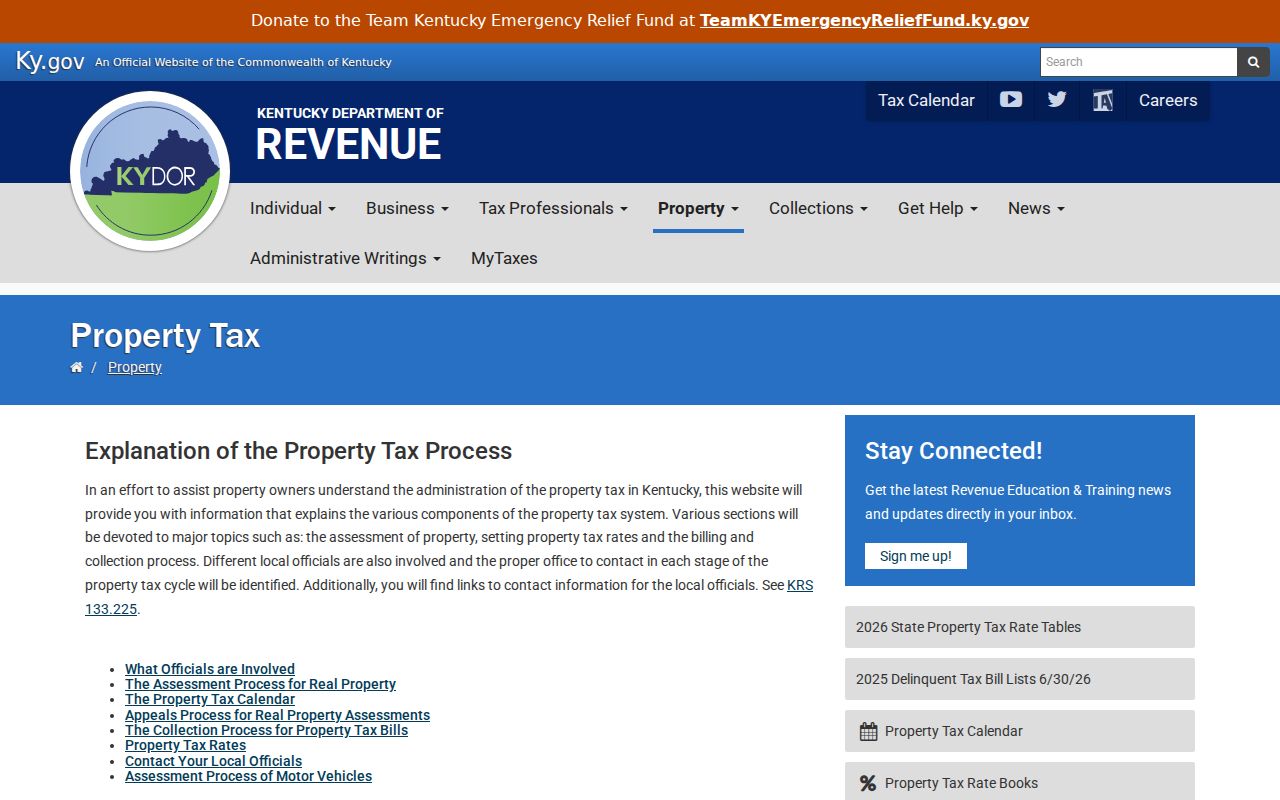
The state page explains assessment and collection rules. It cannot replace the parcel-specific Bell PVA card or your local property tax bill.